Every year when Christmas comes around, my Facebook newsfeed fills with posts related to the holiday. I often see variations of posts decrying the use of the abbreviation Xmas. Every year I try to explain to my Facebook friends why it’s actually not as terrible as they think it is (see below), I haven’t seemed to make any difference from one year to the next.
This one, really minor issue, makes me think of all the other things we don’t get exactly right when it comes to the Christmas story. Very few of these things are matters of significance, but it should encourage us to take another look at the details of the Christmas story.
Xmas
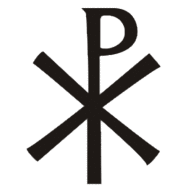
We’ll start with Xmas, since you’re probably very curious by now. The first thing to know is, even though we pronounce “Xmas” as if that first letter is the English letter “x”, actually it’s not. It is the first letter of the Greek word '”christos,” translated Christ. The letter was often used as an abbreviation for Christ.
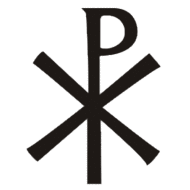
Image from Creative Commons
This symbol is called a labarum. It is a combination of the first two Greek letters of Christ. The “x” is a “chi'” and the “p” is a “rho.”

Image from Creative Commons
Another good example of using the “chi” to stand for Christ is in the acronym “ichthus,” which is where the Jesus fish came from. “Ichthus” is the Greek word for fish, but more importantly is that it uses the first letters of the Greek words “Jesus Christ, Son of God, Savior,” which in Greek is pronounced “Iesous, Christos, Theou, Yios, Soter.”
According to several websites, including
this one at
TLC's How Stuff Works, the “chi” has been used as an abbreviation for the name of Christ since the 16th century, and some variations of it have been used as long ago as 1021. Using the abbreviation Xmas is simply another example of using the “chi” as an abbreviation of Christ.
I won’t dispute that some outside the church may use Xmas in place of Christmas in an attempt to leave Christ out, but it looks like the joke is on them!
Joseph and Mary Travel Alone to Bethlehem

Image from ChristiansUnite.com
“Now in those days a decree went out from Caesar Augustus, that a census be taken of all the inhabited earth. This was the first census taken while Quirinius was governor of Syria. And everyone was on his way to register for the census, each to his own city. Joseph also went up from Galilee, from the city of Nazareth, to Judea, to the city of David which is called Bethlehem, because he was of the house and family of David, in order to register along with Mary, who was engaged to him, and was with child.” Luke 2:1-5 (NASB).
Because everyone was expected to participate in this census, I find it difficult to imagine that Mary and Joseph traveled by themselves to Bethlehem, even though we’ve seen the Christmas card pictures again and again of Mary riding on a donkey and Joseph leading the animal along the road.
Joseph and Mary likely did not travel the most direct route to Bethlehem from Nazareth because that would have taken them through Samaria, which Jews typically went out of their way to avoid. According to the
IVP New Testament Commentary on Luke, this journey would have been about 90 miles and taken approximately three days.
Two people, including a woman advanced in her pregnancy, could not reasonably travel that distance safely by themselves. It is much more likely they joined a caravan as was custom. Notice another example of this later in Luke 2 when Jesus stayed in Jerusalem even though Joseph and Mary were headed back home.
“And as they were returning, after spending the full number of days, the boy Jesus stayed behind in Jerusalem. But His parents were unaware of it, but supposed Him to be in the caravan, and went a day’s journey; and they began looking for Him among their relatives and acquaintances.” Luke 2:43-44 (NASB).
When you think of Joseph and Mary traveling to Bethlehem, picture them in a long caravan of people and probably animals. And speaking of animals, how did we decide they had a donkey? It’s certainly possible, but it’s never stated.
Born in a Barn
“While they were there, the days were completed for her to give birth. And she gave birth to her firstborn son; and she wrapped Him in cloths, and laid Him in a manger, because there was no room for them in the inn.” Luke 2:6-7 (NASB).
The scene of the innkeeper sending Joseph and his pregnant wife away is a typical part of any Christmas play, but I would love to see one that looks more like it actually happened. You can go to
Answers in Genesis to see more about this idea, but I’ll summarize it for you. If you read Luke 2:6-7 without our preconceptions, it sounds like the two had probably been in Bethlehem for a while, rather than just coming in to town as we picture it. It is unlikely they would have not found a place to stay after more than a day, especially since much of their family would have been there with them, whether having traveled along with them or already living in the town.
Further, the word used for “inn” in the second verse is actually a word for guest room. Joseph and Mary were probably staying with family but there was no room in the upper level of the house, so they stayed in the bottom level of the house, which was often used to hold the animals at night. Maybe this could legitimately allow us to say that He was born in a barn, but it is definitely not the rickety wooden building set apart from the inn that we have pictured in our minds. Rather, it is a home, with others present to attend Mary during the birth.
We Three Kings
“Now after Jesus was born in Bethlehem of Judea in the days of Herod the king, magi from the east arrived in Jerusalem, saying, “Where is He who has been born King of the Jews? For we saw His star in the east and have come to worship Him.” Matthew 2:1-2 (NASB).
Our nativity scenes often show Mary and Joseph, Jesus, all the animals, the shepherds, and the wise men all together. I really don’t believe that is accurate.
“Then when Herod saw that he had been tricked by the magi, he became very enraged, and sent and slew all the male children who were in Bethlehem and all its vicinity, from two years old and under, according to the time which he had determined from the magi.” Matthew 2:16 (NASB).
The star appeared at Jesus’ birth, and it seems that, inferring from verse 16, that had been as much as two years prior. The magi were certainly not present at the same time as the shepherds, but much later.
Also, how did we ever decide that there were three magi? There were three gifts: gold, frankincense, and myrrh. We do not know, though, that there was one man per gift.
One of my favorite paintings of the magi is
Adoration of the Magi by Fra Angelico. You can click on this link to view it. I love this one because Jesus is older than a newborn infant and there are eight magi present.
The Christmas season is full of beautiful history, stories, and traditions, but sometimes the church needs to take a step back and look carefully at what we believe. Does the Bible actually say that?